Quick answer: Most multi-location operators are flying blind because combined financials mask location-level problems. In one case, a 3-location dental practice showed $180K total profit, but location-level analysis revealed one site was losing $120K per year. Proper overhead allocation, consistent coding, and location-level P&Ls are the fix.
Multi-Location Financial Management
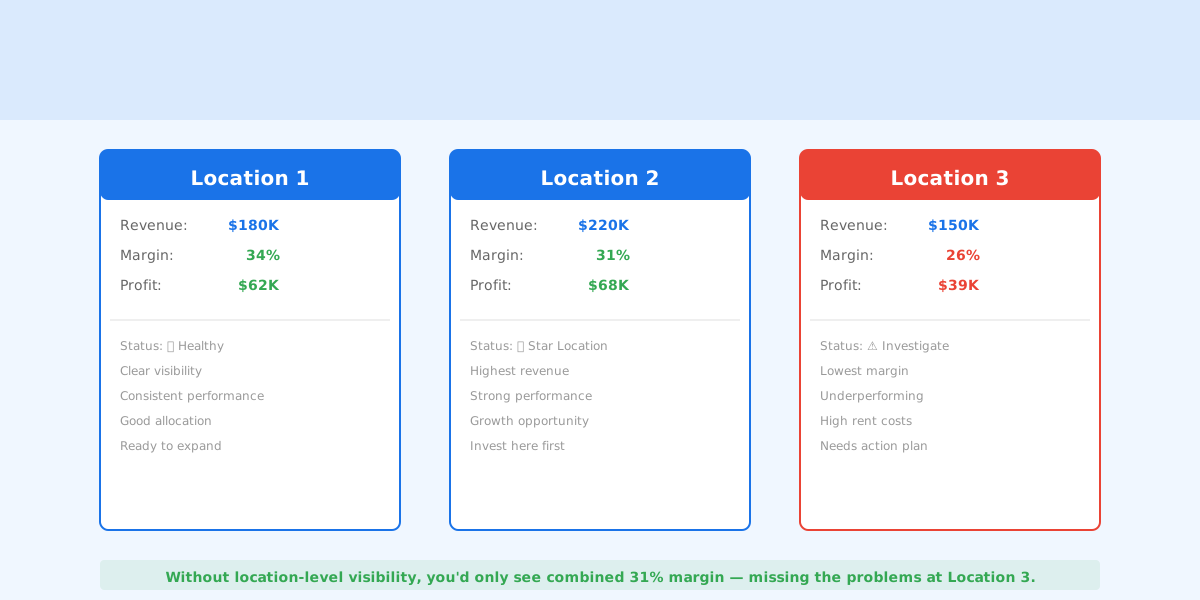 Your three locations might be performing completely differently—you just can't see it without proper structure.
You opened a second location. Congratulations—you're growing!
Then the questions start:
- "Which location is actually profitable?"
- "Why is Location A doing great while Location B is bleeding cash?"
- "How do I allocate overhead between locations?"
- "Can I even trust these numbers?"
If you can't answer these questions with confidence, you have a financial visibility problem.
And it's costing you money.
After helping dozens of multi-location businesses (radiology practices, dental groups, restaurants, marine services) get their finances under control, I can tell you: most multi-location operators are flying blind.
They have some numbers. But they don't have clarity. And without clarity, they can't make good decisions.
Here's how to fix it.
Why Multi-Location Finances Are Different
Single location:
- One set of books
- Clear revenue and expenses
- Easy to see profitability
Multiple locations:
- Consolidation challenges
- Shared expenses (how do you split them?)
- Location-specific performance hidden in combined financials
- Inter-location transactions
- Different management/staff at each location
The trap: You look at combined numbers and think everything's fine—then realize Location 3 has been losing money for 6 months.
The 5 Core Challenges
Challenge #1: Can't See Location-Level Profitability
The problem: Your P&L shows total company profit, but you can't break it down by location.
Why it matters: Location A might be profitable while Location B is dragging you down. Combined, you look okay—but you're making decisions blind.
Example: A 3-location dental practice showed $180K annual profit. When we broke it down:
- Location 1: +$220K
- Location 2: +$80K
- Location 3: -$120K
Location 3 was a cash furnace. But they didn't know because they only looked at combined numbers.
Challenge #2: Shared Expenses Are Allocated Poorly (or Not at All)
The problem: You have corporate overhead (owner salary, central admin, marketing, software, rent for HQ) that benefits all locations. How do you split it?
Why it matters: If you don't allocate overhead properly, you don't know true location profitability.
Common mistakes:
- ❌ Not allocating overhead at all (makes each location look artificially profitable)
- ❌ Splitting evenly (unfair if locations are different sizes)
- ❌ Arbitrary allocation with no logic
Better approach: Allocate based on revenue percentage, headcount, or square footage.
Challenge #3: Inconsistent Processes Between Locations
The problem: Location A codes expenses one way. Location B does it differently. Consolidation becomes a mess.
Why it matters: You can't compare apples to apples. Benchmarking is impossible.
Example: Location A codes all marketing as "Marketing." Location B splits it between "Advertising," "Promotions," and "Events." Good luck comparing.
Challenge #4: Inter-Location Transactions
The problem: Locations share inventory, staff, or resources. How do you track who owes what?
Why it matters: Without proper tracking, you lose visibility and can't see true costs per location.
Example: A restaurant group shares centralized prep kitchen costs. If you don't allocate those costs, each location looks more profitable than it actually is.
Challenge #5: Slow or Nonexistent Consolidation
The problem: Each location has its own books. Nobody consolidates them or it takes weeks.
Why it matters: You're making decisions based on outdated or incomplete data.
Example: CFO asks for consolidated financials on the 15th of the month. Bookkeeper delivers them on the 30th. By then, the data is worthless.
The Solution: The Multi-Location Financial Stack
Here's the system that works for our clients:
Layer 1: Entity Structure
Decision: Separate legal entities vs. divisions of one entity?
Separate entities (LLCs for each location):
- ✅ Liability protection
- ✅ Easier to sell individual locations
- ❌ More tax returns and compliance
- ❌ More complex consolidation
Divisions/locations within one entity:
- ✅ Simpler taxes (one return)
- ✅ Easier consolidation
- ❌ No liability firewall
- ❌ Can't sell just one location easily
Our recommendation: For most service-based multi-location businesses, separate LLCs under a parent holding company gives the best of both worlds.
Layer 2: Accounting System Setup
Option A: One QBO file, multiple locations/classes
How it works:
- Single QuickBooks Online account
- Use "Locations" or "Classes" to tag every transaction
- Reports filtered by location
Pros:
- ✅ Easy to set up
- ✅ Simple consolidation (automatic)
- ✅ One subscription fee
Cons:
- ❌ Harder to sell a location (books are combined)
- ❌ Can get messy with complex inter-location transactions
- ❌ Limited customization per location
Best for: 2-3 locations under one legal entity.
Option B: Separate QBO files, manual consolidation
How it works:
- Each location has its own QBO file
- Roll up to consolidated spreadsheet or reporting tool
Pros:
- ✅ Clean separation
- ✅ Easier to sell individual locations
- ✅ More control per location
Cons:
- ❌ Multiple subscription fees
- ❌ Manual consolidation work
- ❌ Requires discipline to keep consistent
Best for: 3+ locations, separate legal entities, or complex operations.
Option C: ERP or multi-entity accounting software
Examples: NetSuite, Sage Intacct, Xero (with multi-entity setup)
Pros:
- ✅ Built for multi-location
- ✅ Automated consolidation
- ✅ Advanced reporting
Cons:
- ❌ Expensive
- ❌ Complex setup
- ❌ Overkill for most small businesses
Best for: 5+ locations or $10M+ revenue.
The Benefique Multi-Location P&L Structure
Here's the format we use for multi-location clients:
Location-Specific Revenue
| Account | Loc 1 | Loc 2 | Loc 3 | Total |
|---|---|---|---|---|
| Revenue | $180K | $220K | $150K | $550K |
Location-Specific Direct Costs
| Account | Loc 1 | Loc 2 | Loc 3 | Total |
|---|---|---|---|---|
| Staff wages | $45K | $60K | $50K | $155K |
| Rent | $8K | $12K | $7K | $27K |
| Supplies | $12K | $15K | $10K | $37K |
| Utilities | $2K | $3K | $2K | $7K |
| Other direct | $5K | $6K | $4K | $15K |
| Total Direct Costs | $72K | $96K | $73K | $241K |
Location Gross Profit
| Loc 1 | Loc 2 | Loc 3 | Total | |
|---|---|---|---|---|
| Gross Profit | $108K | $124K | $77K | $309K |
| Gross Margin | 60% | 56% | 51% | 56% |
Shared/Corporate Overhead (Allocated)
| Account | Loc 1 | Loc 2 | Loc 3 | Total |
|---|---|---|---|---|
| Owner salary | $18K | $22K | $15K | $55K |
| Admin staff | $10K | $12K | $8K | $30K |
| Marketing (corporate) | $6K | $7K | $5K | $18K |
| Software/IT | $3K | $4K | $3K | $10K |
| Insurance | $4K | $5K | $3K | $12K |
| Other overhead | $5K | $6K | $4K | $15K |
| Total Overhead | $46K | $56K | $38K | $140K |
Allocated based on % of revenue
Location Net Profit
| Loc 1 | Loc 2 | Loc 3 | Total | |
|---|---|---|---|---|
| Net Profit | $62K | $68K | $39K | $169K |
| Net Margin | 34% | 31% | 26% | 31% |
Key Insights from This Format
1. Location 2 has the highest revenue AND highest gross profit
This is your star location.
2. Location 3 has the lowest margin (26% vs. 34%)
Investigate why. Higher rent? Lower prices? Inefficient operations?
3. Combined margin is 31%
But if you only looked at total numbers, you'd miss that Location 3 is lagging.
4. Overhead is allocated fairly based on revenue %
If Location 1 generates 33% of revenue, it gets 33% of overhead.
Overhead Allocation Methods
Method 1: Revenue %
How it works: Each location gets a % of overhead equal to its % of total revenue.
Pros: Simple, fair for revenue-based businesses
Cons: Penalizes high-revenue locations even if they're efficient
Best for: Service businesses where revenue is the key driver
Method 2: Headcount %
How it works: Allocate based on number of employees per location.
Pros: Fair for labor-intensive businesses
Cons: Ignores revenue differences
Best for: Businesses where labor is the primary cost
Method 3: Square Footage %
How it works: Allocate based on physical space.
Pros: Fair for rent-heavy businesses
Cons: Ignores revenue and efficiency
Best for: Retail, restaurants, warehouses
Method 4: Hybrid
How it works: Split overhead into categories and allocate each differently:
- Marketing → Revenue %
- HR/Admin → Headcount %
- IT → Number of devices/users
- Owner salary → Revenue %
Pros: Most accurate
Cons: More complex
Best for: Larger multi-location businesses
Location-Level KPIs: What to Track
Beyond P&L, track these metrics per location:
Financial KPIs
- Revenue per location
- Gross profit per location
- Net profit per location
- Revenue per square foot (retail/restaurants)
- Revenue per employee
- Cost per sale (customer acquisition cost)
Operational KPIs
- Number of customers/patients served
- Average transaction size
- Repeat customer rate
- Employee turnover rate
- Inventory turnover (if applicable)
Benchmarking
Compare locations to each other:
- Best performer vs. worst performer
- Revenue trends over time
- Cost structure differences
Example dashboard:
| Location | Revenue | Margin | Customers | Rev/Customer | Rev/Employee |
|---|---|---|---|---|---|
| Loc 1 | $180K | 34% | 450 | $400 | $30K |
| Loc 2 | $220K | 31% | 520 | $423 | $31K |
| Loc 3 | $150K | 26% | 410 | $366 | $25K |
Insight: Location 3 has lower revenue per customer AND lower revenue per employee. This suggests either pricing is too low or efficiency is poor.
Real Client Example: 3-Location Radiology Practice
Client: A multi-location radiology group, 3 locations, $8M annual revenue
Problem:
- Combined financials looked fine
- Couldn't see profitability by location
- Month-end close took 3 weeks
- Couldn't answer: "Which location should we invest in?"
What we did:
1. Restructured chart of accounts
- Created consistent account codes across all 3 locations
- Tagged every transaction with location
- Separated direct costs from allocated overhead
2. Built location-level P&Ls
- Real-time dashboards showing each location's performance
- Weekly reports instead of waiting for month-end
3. Allocated corporate overhead fairly
- Owner/admin salaries split by revenue %
- IT costs split by number of devices
- Marketing split by patient volume
Results:
- Discovered their lowest-performing center was underperforming due to higher rent and lower patient volume
- Renegotiated lease, saving $18K/year
- Shifted marketing budget toward Location 1 and 3 (better ROI)
- Improved overall margins by 12%
- Month-end close: 3 weeks → 1 day
Cost of solution: Monthly CFO advisory + dashboard setup
Value: $50K+ in identified savings + confident decision-making
Common Multi-Location Mistakes
Mistake #1: Opening Location 2 Before Location 1 Is Profitable
The trap: "We're growing! Let's expand!"
Reality: If Location 1 isn't solidly profitable and systematized, Location 2 will drain cash and attention.
Fix: Don't expand until Location 1 runs without you and generates consistent profit.
Mistake #2: No Standard Operating Procedures
The trap: Each location does things their own way.
Reality: You can't scale chaos. Inconsistency kills profitability.
Fix: Document processes. Train consistently. Audit regularly.
Mistake #3: Ignoring Underperforming Locations Too Long
The trap: "Location 3 will turn around eventually."
Reality: 6 months becomes 2 years. You've burned $200K.
Fix: Set clear performance benchmarks. If a location isn't hitting them after 6-12 months, make tough decisions (new management, restructure, or close).
Mistake #4: Not Tracking Inter-Location Transactions
The trap: Locations borrow inventory, share staff, or transfer funds without tracking.
Reality: Books become a mess. You don't know true costs.
Fix: Treat inter-location transactions like customer/vendor transactions. Track them properly.
Mistake #5: Over-Allocating Overhead
The trap: Allocating so much overhead that no location looks profitable.
Reality: You lose motivation to grow.
Fix: Only allocate overhead that truly benefits all locations. Some corporate costs (like acquisition expenses) shouldn't be allocated.
When to Expand to Location 3, 4, 5+
You're ready when:
✅ Location 1 is consistently profitable (12+ months)
✅ Location 1 runs without daily owner involvement
✅ You have documented SOPs for every key process
✅ You have reliable financial reporting (current books, location-level P&Ls)
✅ You have cash reserves (6 months operating expenses minimum)
✅ You understand what makes Location 1 successful (and can replicate it)
You're NOT ready when:
❌ Location 1 still requires constant firefighting
❌ You can't answer "Why is Location 1 profitable?"
❌ Your books are a mess
❌ You're relying on debt to fund expansion
❌ You haven't tested your systems/processes thoroughly
Pro tip: Location 2 is the hardest. If you can successfully run 2 locations, scaling to 3+ is easier because you've figured out the systems.
The Fractional CFO Advantage
Multi-location businesses benefit massively from CFO-level guidance—but most can't afford a full-time CFO.
Fractional CFO services include:
- Location-level financial reporting
- Overhead allocation strategy
- KPI dashboards
- Monthly financial reviews
- Expansion feasibility analysis
- Cash flow forecasting across locations
- Performance benchmarking
Cost: Fraction of a full-time CFO
Value: Strategic visibility + confident decision-making
We work with several multi-location healthcare, service, and hospitality businesses across South Florida. This is what we do.
Next Steps: Get Location-Level Visibility
This week:
- Identify your current gaps (Can you see profitability by location? How long does consolidation take?)
- Choose your accounting structure (Single QBO with locations? Separate files? Other?)
- Define overhead allocation (How will you split shared costs?)
- Set up location tagging (Ensure every transaction is tagged with location)
- Build location-level P&Ls (Even a simple version is better than nothing)
This month:
- Establish KPIs per location
- Train your team on consistent coding/tagging
- Review location performance with managers
- Benchmark locations against each other
- Make data-driven decisions (invest in winners, fix or close losers)
Need Help?
We specialize in multi-location financial management.
Our clients include:
- Multi-location radiology practices
- Dental groups
- Restaurant groups
- Marine services with multiple entities
- Professional services with multiple offices
We provide:
- Location-level P&Ls and dashboards
- Real-time financial visibility
- Strategic CFO guidance
- Expansion feasibility analysis
Interested? Apply to work with us or email hello@benefique.com.
Final Thoughts
You can't manage what you can't measure.
If you're running multiple locations but can't see per-location profitability, you're guessing—not managing.
Get visibility. Make better decisions. Grow profitably.
That's what we help businesses do.
Disclaimer: This article is for informational purposes only and does not constitute tax, legal, or financial advice. Tax situations vary — consult a qualified tax professional for advice specific to your circumstances.
Frequently Asked Questions
How do I know if each of my business locations is actually profitable?
You need location-level P&L statements that separate direct costs (staff wages, rent, supplies) from properly allocated corporate overhead. Without this breakdown, combined financials can mask that one location is losing money. In one case, a 3-location dental practice showed $180K total profit, but location-level analysis revealed one site was losing $120K per year.
What is the best way to allocate shared overhead costs across multiple locations?
The most common methods are revenue percentage, headcount percentage, square footage percentage, or a hybrid approach. Revenue-based allocation works well for service businesses, headcount works for labor-intensive operations, and the hybrid method — splitting different overhead categories by different drivers — is the most accurate for larger multi-location businesses.
Should I use one QuickBooks file or separate files for multiple locations?
For 2-3 locations under one legal entity, a single QBO file with location or class tags is simpler and provides automatic consolidation. For 3+ locations, separate legal entities, or complex operations, separate QBO files give cleaner separation and make it easier to sell individual locations, though they require manual consolidation.
When is my business ready to open another location?
You should have at least 12 months of consistent profitability at your existing locations, documented SOPs for every key process, reliable financial reporting with location-level P&Ls, cash reserves covering 6 months of operating expenses, and the ability to run your first location without daily owner involvement.
What financial KPIs should I track for each location?
Track revenue per location, gross profit margin, net profit margin, revenue per employee, revenue per square foot (for retail or restaurants), average transaction size, and customer or patient count. Comparing these metrics across locations helps you identify which sites are underperforming and where to focus improvement efforts.