Quick answer: Healthcare practices routinely qualify for R&D tax credits worth $40,000-$120,000 per year and don't know it. The credit is dollar-for-dollar against your tax bill -- not a deduction -- and you can amend returns for the past 3 years. One multi-location radiology practice claimed $91,400 in credits on $457,000 in qualified research expenses.
When you hear "R&D tax credits," you probably think of tech startups and pharmaceutical companies.
You don't think of your radiology practice, dental group, or veterinary clinic.
That's a mistake that's costing you tens of thousands of dollars.
The Research & Development tax credit is one of the most valuable—and most overlooked—tax benefits available to healthcare practices. We've helped practices recover $40,000-$120,000 in credits they didn't know they qualified for.
Here's what you need to know.
What Are R&D Tax Credits?
The R&D tax credit is a dollar-for-dollar reduction in your federal tax bill (and often state taxes too) for qualified research activities.
Key benefits:
- Federal credit: Up to 20% of qualified R&D expenses
- State credits: Florida doesn't have state income tax, but other states offer additional credits
- Refundable: Small businesses can use credits against payroll taxes
- Retroactive: You can amend returns up to 3 years back
Translation: If you spent $200K on qualified R&D activities, you could get a $40K tax credit. Not a deduction—a credit. Real money back.
Working with a fractional CFO can help identify qualified R&D activities you might be missing.
The Healthcare Misconception
Common belief: "We're not a research lab. We see patients. R&D doesn't apply to us."
Reality: The IRS defines "research" much more broadly than most people think.
You don't need white coats and test tubes. You need:
- Technical uncertainty (trying to figure something out)
- Process of experimentation (testing different approaches)
- Technological in nature (based on hard sciences—biology, medicine, engineering)
- New or improved business component (process, technique, formula, software)
Healthcare practices do this ALL THE TIME. They just don't document it.
What Qualifies: Healthcare Examples
Radiology Practices
Qualifying activities:
- Implementing new imaging protocols or techniques
- Testing and optimizing MRI/CT scanner settings for specific conditions
- Developing workflows to reduce patient exposure or scan times
- Integrating AI diagnostic tools and evaluating effectiveness
- Customizing image processing software
- Redesigning patient positioning techniques to improve image quality
Example: A multi-location radiology practice spent 6 months optimizing their MRI protocols to reduce scan times by 30% without losing image quality. They tested different sequences, consulted with radiologists, and documented outcomes.
Result: $62,000 in R&D credits claimed retroactively for 3 years.
Dental Practices
Qualifying activities:
- Developing new treatment protocols (sedation, implant placement, etc.)
- Testing and refining CAD/CAM workflows
- Evaluating new materials or techniques (bonding agents, filling materials)
- Designing custom surgical guides or workflows
- Integrating digital imaging and treatment planning software
- Experimenting with sterilization or infection control processes
Example: A dental group spent significant time testing different implant placement techniques for patients with bone loss. They documented protocols, success rates, and modifications over 18 months.
Result: $38,000 in credits.
Veterinary Clinics
Qualifying activities:
- Developing new surgical techniques for specific conditions
- Testing anesthesia protocols for exotic animals or high-risk patients
- Evaluating new diagnostic equipment or imaging techniques
- Creating custom treatment plans for rare conditions
- Experimenting with pharmaceutical compounding or dosing
- Designing improved clinic workflows or equipment setups
Example: A specialty vet clinic developed a new surgical approach for a complex orthopedic condition in dogs. They tested variations, documented outcomes, and refined the technique over time.
Result: $45,000 in credits.
Multi-Specialty Medical Practices
Qualifying activities:
- Implementing electronic health records (EHR) systems with custom workflows
- Developing patient care protocols for chronic conditions
- Testing new telemedicine or remote monitoring technologies
- Creating custom medical devices or equipment modifications
- Experimenting with practice management software integrations
- Optimizing clinical workflows to reduce wait times or improve outcomes
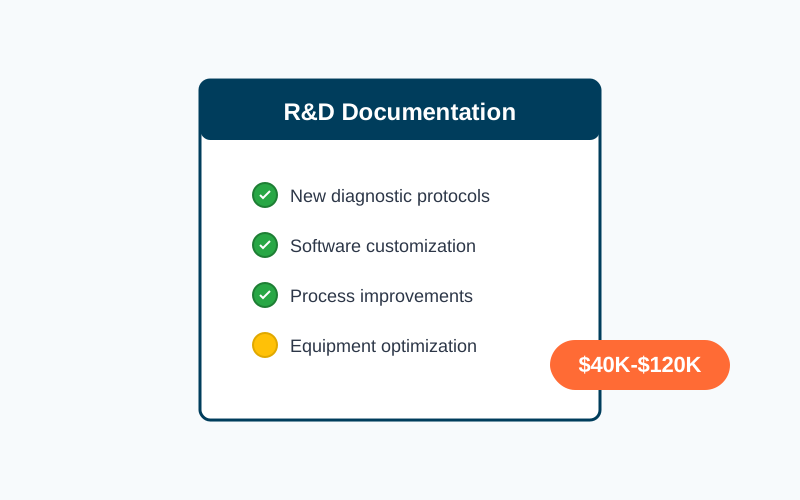 Common R&D activities in healthcare practices that qualify for tax credits
The 4-Part Test: Does Your Activity Qualify?
The IRS uses a 4-part test. ALL four must be met:
1. Permitted Purpose
Your activity must aim to:
- Create a new or improved business component (process, technique, formula, software, etc.)
Healthcare translation: New treatment protocol, improved workflow, optimized equipment setup, custom software integration.
✅ Yes: Developing a new patient intake workflow to reduce wait times
❌ No: Buying new equipment off-the-shelf with no modification
2. Technical Uncertainty
You must be trying to eliminate uncertainty about:
- The appropriate design of the business component
- The capability or method for developing or improving it
Healthcare translation: You didn't know if your approach would work. You had to figure it out.
✅ Yes: Testing whether a new imaging protocol would work without sacrificing quality
❌ No: Following a standard procedure from a textbook with no modification
3. Process of Experimentation
You must:
- Evaluate alternatives
- Test different approaches
- Refine based on results
Healthcare translation: You tried multiple options. You documented what worked and what didn't. You iterated.
✅ Yes: Tested 5 different sedation protocols, tracked outcomes, selected the best
❌ No: Used the manufacturer's recommended settings with no testing
4. Technological in Nature
The experimentation must:
- Rely on principles of biology, medicine, engineering, computer science, or other hard sciences
Healthcare translation: This is healthcare. Almost everything qualifies here.
✅ Yes: Anything involving medical techniques, equipment optimization, or software
❌ No: Marketing campaigns, administrative improvements unrelated to patient care
Common Healthcare R&D Activities (You're Probably Doing These)
Equipment & Technology
- Testing and optimizing medical equipment settings
- Integrating new diagnostic or treatment technologies
- Developing custom equipment modifications or attachments
- Evaluating software tools for clinical use
- Automating or streamlining technical workflows
Clinical Processes
- Developing new treatment protocols or techniques
- Experimenting with materials, drugs, or dosing
- Creating standardized procedures for complex conditions
- Testing infection control or sterilization methods
- Designing surgical or procedural workflows
Software & Systems
- Customizing EHR or practice management software
- Building integrations between clinical systems
- Developing patient portals or telehealth platforms
- Creating custom reporting or analytics tools
- Automating clinical documentation
Patient Care Improvements
- Reducing wait times through workflow redesign
- Improving patient safety through process changes
- Enhancing diagnostic accuracy through protocol development
- Testing new patient communication or education methods (when tech-based)
What Expenses Qualify?
Once you identify qualifying activities, you need to calculate qualified research expenses (QREs).
QREs Include:
1. Wages
- Salaries of employees performing or supervising R&D activities
- Doctors, nurses, technicians, IT staff, engineers
- Only the time spent on qualifying activities (not all wages)
Example: If your lead radiologist spent 20% of their time developing the new imaging protocol, 20% of their salary qualifies.
2. Supplies
- Materials consumed in the research process
- Testing materials, prototypes, trial materials
- Must be used up (not equipment)
Example: Materials used during the testing phase of a new dental material.
3. Contract Research
- 65% of amounts paid to third parties to perform R&D on your behalf
- Consultants, engineers, specialists hired for the project
Example: Paid a software developer to build a custom EHR integration? 65% qualifies.
4. Computer Lease/Cloud Costs (if used for R&D)
- Hosting, servers, software used specifically for qualifying activities
What Doesn't Qualify:
❌ General overhead (rent, utilities, admin salaries)
❌ Marketing or patient acquisition costs
❌ After-the-fact documentation (must be during development)
❌ Equipment purchases (these go through regular depreciation)
How to Claim R&D Credits
Step 1: Identify Qualifying Activities (Past 3 Years)
Questions to ask yourself:
- Did we implement any new processes, protocols, or technologies?
- Did we test different approaches to solve a problem?
- Did we customize or modify equipment or software?
- Did we develop anything proprietary or unique?
Pro tip: Talk to your clinical staff. They're doing the work and often don't realize it qualifies.
Step 2: Document Everything
The IRS wants contemporaneous documentation. This means documentation created DURING the activity, not after.
What to gather:
- Project notes, meeting minutes, protocols
- Test results, outcome tracking, iteration logs
- Emails discussing the project
- Before/after comparisons
- Time tracking (who worked on it, how long)
- Expense records (supplies, contractors, etc.)
Don't have documentation? You can still claim credits with reasonable reconstructions, but contemporaneous docs are stronger.
Step 3: Calculate Qualified Expenses
Work with your EA, CPA, or an R&D credit specialist to:
- Identify employee time spent on qualifying activities
- Calculate wage expenses (salary + benefits × time %)
- Add supply costs and contractor fees
- Apply the appropriate credit rate (typically 7-10% for most taxpayers)
Step 4: File Form 6765
This is the R&D credit claim form. It goes with your tax return.
Options:
- Regular Credit Method: Simpler, based on current-year spending minus a base amount
- Alternative Simplified Credit (ASC): Often better for healthcare practices with no prior R&D history
Small business bonus: If you have less than $5M in revenue and are less than 5 years old, you can apply credits against payroll taxes (up to $500K/year).
Step 5: Amend Prior Years (If Applicable)
You can amend returns for the past 3 years to claim missed credits.
Example: If you qualified in 2023, 2024, and 2025 but never claimed, you can amend all three and get refunds.
Real Client Example: Multi-Location Radiology Practice
Client: 3-location radiology practice, 12 radiologists, $8M annual revenue
Qualifying activities (identified retroactively for 3 years):
- Developed proprietary imaging protocols for specific sports injuries
- Integrated and customized AI diagnostic software
- Optimized scanner settings to reduce radiation exposure
- Built custom reporting system connecting to referring physicians' EHRs
Qualified expenses:
- Radiologist time: $320,000 (estimated 15% of annual wages over 3 years)
- IT staff time: $80,000
- Software consultants: $45,000 (65% of contractor fees)
- Supplies/testing: $12,000
Total QREs: $457,000
Credits claimed (3 years): $91,400 (20% rate)
Refund received: $91,400
Cost of R&D study: $12,000
Net benefit: $79,400
That paid for a new MRI down payment.
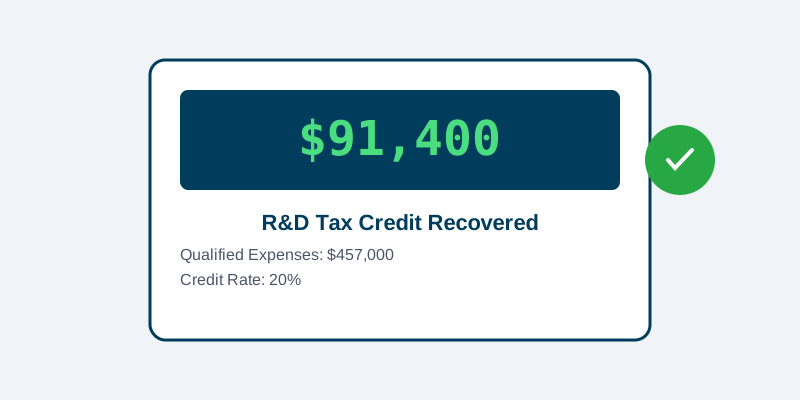 Real example: $457K in qualified expenses = $91.4K tax credit recovered
💡 Think you might qualify for R&D credits?
Most healthcare practices leave $40K-$120K on the table every year. Our team has helped recover millions in overlooked R&D credits for South Florida practices.
Schedule a free R&D credit assessment →
Common Objections (And Why They're Wrong)
"We're too small."
Wrong. There's no revenue minimum. Small practices often have higher qualifying percentages because owners are hands-on.
"We didn't keep good records."
Partially true. Contemporaneous docs are best, but you can reconstruct based on emails, calendars, and interviews. Not ideal, but workable.
"The IRS will audit us."
Unlikely. R&D credits have lower audit rates than most assume. And if you're audited, good documentation = smooth process.
"Our accountant never mentioned it."
Common. Many tax professionals focus on compliance, not credits. R&D credits require specialized knowledge and extra work. If your EA or CPA isn't bringing it up, ask why.
"We already filed our taxes."
Not a problem. Amend. You have 3 years from the filing date to amend and claim missed credits.
Mistakes to Avoid
Mistake #1: Not Tracking Time
The problem: You can't prove how much time staff spent on qualifying activities.
The fix: Start tracking now. For past years, reconstruct based on project timelines and interviews.
Mistake #2: Over-claiming
The problem: Claiming routine activities as R&D. The IRS will disallow.
The fix: Be conservative. Only claim activities that truly meet the 4-part test.
Mistake #3: DIY Without Expertise
The problem: R&D credit calculations are complex. Errors lead to missed money or IRS issues.
The fix: Work with a qualified tax professional who has healthcare R&D experience.
Mistake #4: Not Documenting Prospectively
The problem: You're doing qualifying work now but not documenting it.
The fix: Start documenting today. Project logs, meeting notes, outcome tracking.
How to Start Documenting for Future Years
Set up a simple system:
1. Create a "Projects" log
- What you're trying to accomplish
- Why it's uncertain (what you don't know)
- Different approaches you're testing
2. Track time
- Who's working on the project
- Roughly how much time they're spending
3. Save communications
- Emails about the project
- Meeting notes
- Test results and outcomes
4. Document before/after
- Baseline metrics (before)
- Results and improvements (after)
5. Quarterly review
- Every 3 months, review projects with your tax professional
- Identify what might qualify
- Adjust documentation as needed
Next Steps: Find Your Hidden Credits
Do This Week:
1. Review the last 3 years
What new processes, technologies, or protocols did you implement?
2. Talk to your clinical staff
Ask: "What have we developed, tested, or optimized?"
3. Gather documentation
Project notes, emails, timelines—anything that shows experimentation.
4. Talk to your tax professional
Ask: "Have you evaluated us for R&D credits?"
If the answer is "no" or "you don't qualify," get a second opinion.
Related reading:
- S-Corp Election: Is It Right for Your Florida Business?
- Cash Flow Forecasting for Healthcare Practices
- Real-Time Dashboards That Actually Get Used
We Specialize in Healthcare R&D Credits
At Benefique, we work with radiology practices, dental groups, veterinary clinics, and medical practices across South Florida.
We know:
- What healthcare activities qualify
- How to document properly
- How to maximize your credit
- How to defend it in an audit (if needed)
Typical ROI: 5:1 to 10:1. For every dollar you spend on the R&D study, you get $5-$10 back in credits.
Interested? Apply to work with us or email hello@benefique.com.
Final Thoughts
If you're a healthcare practice that has implemented new processes, technologies, or protocols in the last 3 years, you're probably leaving money on the table.
The average healthcare practice we work with recovers $40,000-$80,000 in missed credits.
That's real money. Money that can pay for equipment, hire staff, or just end up in your pocket.
Don't leave it with the IRS.
Disclaimer: This article is for informational purposes only and does not constitute tax, legal, or financial advice. Tax situations vary — consult a qualified tax professional for advice specific to your circumstances.
Frequently Asked Questions
How much can a healthcare practice recover in R&D tax credits?
The average healthcare practice Benefique works with recovers $40,000-$80,000 in missed credits. A multi-location radiology practice with $457,000 in qualified research expenses claimed $91,400 in credits over three years after a retroactive study.
What healthcare activities qualify for the R&D tax credit?
Qualifying activities include implementing new imaging protocols, developing custom EHR integrations, testing and optimizing medical equipment settings, creating new treatment protocols, building custom software tools, and experimenting with clinical processes. The key is that the activity must involve technical uncertainty, a process of experimentation, and a technological basis.
Can I claim R&D credits if I already filed my tax returns?
Yes. You can amend returns for the past three years to claim missed credits using Form 6765. If you qualified in 2023, 2024, and 2025 but never claimed, you can amend all three years and receive refunds.
What is the difference between an R&D tax credit and a tax deduction?
A tax credit reduces your tax bill dollar-for-dollar, while a deduction only reduces your taxable income. A $10,000 R&D credit saves you $10,000 in taxes, whereas a $10,000 deduction at a 32% tax rate saves only $3,200. Credits are roughly three times more powerful than deductions.
Can small healthcare practices apply R&D credits against payroll taxes?
Yes. If your practice has gross receipts under $5 million and is in its first five years of having qualifying R&D expenses, you can apply up to $500,000 of the R&D credit against payroll taxes (Social Security portion). This is especially valuable for newer practices that may not have enough income tax liability to use the full credit.